


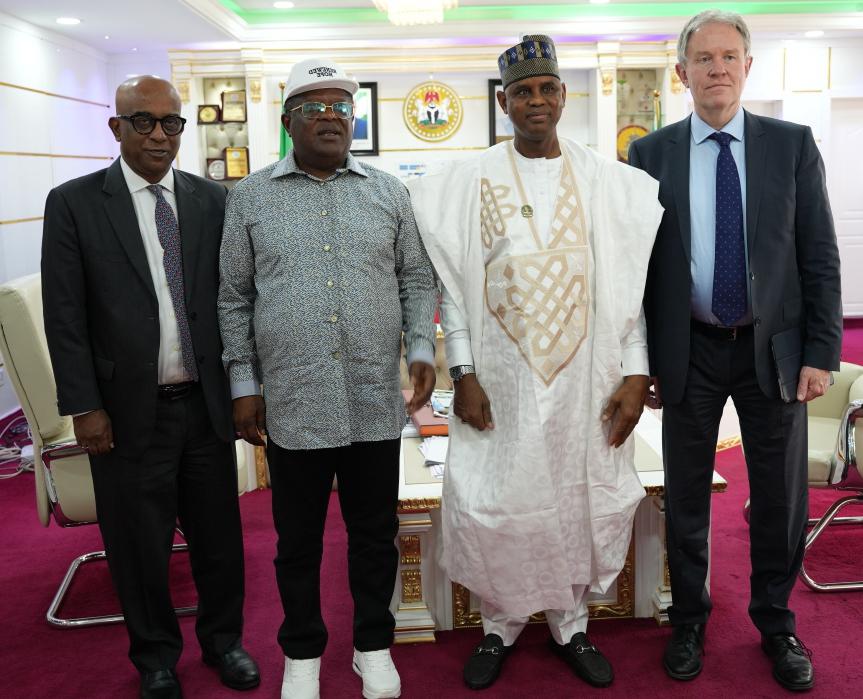
Minister of Works, David Umahi, has met with a high-level delegation from the World Bank, as efforts intensify to strengthen the country’s road infrastructure.
The meeting, held at the Minister’s office in Abuja, focused on improving road development and maintenance across the country, amid funding constraints and rising construction costs.
Umahi told the delegation that infrastructure development remains critical to Nigeria’s economic growth, noting that efficient road networks are key to trade, mobility, and national development.
He briefed the World Bank team on the Federal Government’s “Build, Update and Maintain” strategy, under which government constructs roads while the private sector is engaged for maintenance, a model aimed at ensuring sustainability and value for money.
The Minister explained that the rising cost of road construction and limited funding have posed major challenges, adding that the Ministry has shifted from asphalt to reinforced concrete pavement, which he described as more durable and cost-effective in the long term.
Senator Umahi listed priority projects currently under construction to include the East–West Road, the Enugu–Onitsha Road, the Kano–Jigawa–Maiduguri corridor, and the Lagos–Ibadan Expressway.
He disclosed that upon assumption of office, the Ministry inherited hundreds of failed road sections and dilapidated bridges nationwide, prompting President Bola Ahmed Tinubu to approve twenty billion naira for the completion of critical projects, many of which are now being commissioned.
The Minister stressed that new projects would not be initiated until ongoing ones are completed, and formally requested the World Bank to consider funding road projects through the Federal Ministry of Works, with tolling introduced to ensure sustainability and repayment.
Responding, the World Bank delegation, led by Matthew Verghis, said the visit was aimed at exploring practical ways to improve Nigeria’s road infrastructure, describing roads as the country’s most important infrastructure asset.
Another member of the delegation, Franz Drees-Gross, noted that infrastructure development plays a key role in job creation and poverty reduction, highlighting areas of interest such as improved drainage systems, state road maintenance frameworks, and increased private sector participation.
The World Bank also emphasized that any funding would be subject to strict procurement standards to ensure transparency and accountability.
The meeting ended with both sides expressing commitment to deeper collaboration towards sustainable and resilient infrastructure development in Nigeria.
The Minister of State for Works, Bello Mohammed Goronyo, later thanked the delegation and reaffirmed the Ministry’s readiness to work closely with the World Bank.

